
Introduction
El Niño is one of the most powerful natural climate phenomena on Earth. It affects weather patterns across the world, changing rainfall, temperature, storms, agriculture, fisheries, and even economies. Some countries experience heavy rainfall and floods, while others suffer from droughts, wildfires, and food shortages.
The term “El Niño” comes from Spanish and means “The Little Boy” or “Christ Child,” because fishermen in South America noticed warm ocean water appearing around Christmas time. Today, scientists understand El Niño as part of a larger climate system called the El Niño-Southern Oscillation (ENSO).
El Niño is not just an ocean event—it is a global atmospheric and oceanic interaction that impacts millions of people. Understanding El Niño helps governments, farmers, scientists, and communities prepare for both its benefits and dangers.
This article explains El Niño topic-wise, including its history, science, present effects, future importance, benefits, and harmful impacts on the world.
What is El Niño?
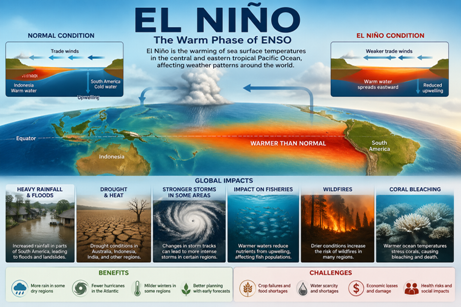
El Niño is the warming of sea surface temperatures in the central and eastern tropical Pacific Ocean, especially near the west coast of South America.
Normally:
- Trade winds blow from east to west
- Warm water moves toward Asia and Australia
- Cold water rises near Peru and Ecuador
During El Niño:
- Trade winds weaken
- Warm water moves back toward South America
- Cold water upwelling decreases
- Ocean temperature rises
This change disturbs global weather systems.
It usually occurs every 2 to 7 years and lasts for 9 to 12 months, though some strong events last longer.
El Niño and ENSO System
El Niño is one part of the ENSO cycle:
Three Phases of ENSO
A. Normal Phase
- Strong trade winds
- Warm water near Indonesia
- Cold water near South America
- Balanced rainfall pattern
B. El Niño Phase
- Weak trade winds
- Warm water shifts east
- Heavy rain in Americas
- Drought in Asia and Australia
C. La Niña Phase
- Stronger-than-normal trade winds
- More cold water rises
- Heavy rain in Asia
- Drier Americas
La Niña is often considered the opposite of El Niño.
History of El Niño
Ancient Observations
Peruvian fishermen noticed warm ocean water centuries ago. They observed:
- Fish disappearing
- Changes in rainfall
- Unusual storms
They called it “El Niño” because it often appeared near Christmas.
Scientific Discovery
In the 19th and 20th centuries, scientists began studying this pattern.
Sir Gilbert Walker
A British scientist, Sir Gilbert Walker, studied atmospheric pressure changes between the Pacific and Indian Oceans and discovered the Southern Oscillation.
Later, scientists connected this atmospheric pattern with ocean warming and named it ENSO.
Famous Historical El Niño Events
1982–83 El Niño
One of the strongest events:
- Massive floods in Peru
- Severe drought in Australia
- Fishery collapse
- Billions of dollars in damage
1997–98 El Niño
Extremely powerful:
- Global floods and fires
- Crop losses
- Coral bleaching
- Economic losses over $30 billion
2015–16 El Niño
Very strong modern event:
- Record temperatures
- Drought in India
- Wildfires in Indonesia
- Agricultural losses worldwide
2023–24 El Niño
Recent major event:
- Heat waves
- Water shortages
- Strong storms
- Food security concerns
Agriculture Impact
Harmful Effects
Drought
Countries like:
- India
- Australia
- Indonesia
- Southern Africa
may face:
- Crop failure
- Low rice production
- Water shortages
Flooding
Countries like:
- Peru
- Ecuador
- United States
may suffer:
- Crop destruction
- Soil erosion
- Farm damage
Some Benefits
Some regions receive useful rainfall and improved growing conditions depending on local climate.
Fisheries Impact
Normally, cold water near Peru brings nutrients upward, supporting fish.
During El Niño:
- Upwelling decreases
- Nutrients reduce
- Fish populations decline
This harms:
- Anchovy fishing
- Local economy
- Seafood supply chains
This is one of the earliest known effects of El Niño.
Health Impact
Diseases Increase
Because of floods and heat:
- Malaria
- Dengue
- Cholera
- Heatstroke
may rise.
Food Insecurity
Crop losses cause:
- Hunger
- Malnutrition
- Poverty
especially in vulnerable countries.
Environmental Impact
Wildfires
Dry conditions cause fires in:
- Australia
- Indonesia
- Amazon rainforest
Coral Bleaching
Warmer oceans stress coral reefs:
- Coral turns white
- Marine biodiversity decreases
Glacier and Ice Changes
Temperature rise affects:
- Polar ice
- Mountain glaciers
which impacts sea level.
Environmental Impact
El Niño causes major financial losses:
- Agriculture losses
- Insurance claims
- Infrastructure damage
- Energy shortages
- Food price increases
Global losses can reach tens of billions of dollars.
Poor countries suffer the most because recovery is difficult.
Conclusion
El Niño is one of the most important climate systems on Earth. It begins in the Pacific Ocean, but its effects reach every continent. It can bring life-saving rain to dry regions and reduce hurricanes, but it can also cause devastating floods, droughts, wildfires, food shortages, and economic crises.
From ancient Peruvian fishermen to modern satellites and AI forecasting, human understanding of El Niño has grown greatly. Yet its power remains enormous.
As climate change increases uncertainty, understanding El Niño becomes even more important for the future of agriculture, environment, economy, and human survival.
